Surgery fixed the structure. But being cleared by your surgeon isn’t the same as being ready to train, compete, lift, run, or move through your life without second-guessing every step.

Post-surgical rehabilitation is the structured process of rebuilding strength, movement, and confidence after an orthopedic surgery. It picks up where your surgeon left off and focuses on getting your body ready to perform again.
Most people finish their insurance-based PT at three to six months post-op and feel better than they did right after surgery. But better than surgery day isn’t the same as ready. There is often a significant gap between where insurance-based PT ends and where you need to be to return to full training, competition, or the physical demands of your daily life.
That gap is what we close.
This page is for you if you have had an orthopedic surgery and you still don’t feel strong, stable, or like yourself.
Maybe you were discharged from post-op PT and plateaued. Maybe you never started formal rehab and now you’re trying to figure out how to get back on your own. Maybe you feel functional in daily life but you’re nowhere near ready to train at the level you were before.
If any of that is where you’re right now, this is the right page.
Most post-surgical rehab gets the early stuff right. It helps manage swelling, restores basic range of motion, and gets you walking more normally again.
That matters. But feeling better than you did right after surgery doesn’t mean you’re ready to train, compete, lift, run, or trust your body again. You need strength. Loading capacity. Control. Confidence.
The ability to absorb force, change direction, and perform under fatigue.
Those aren’t extras. They’re the difference between getting through surgery and actually getting back.
Research in the Journal of Orthopaedic and Sports Physical Therapy has shown that strength deficits can still be present after standard post-surgical PT. Those deficits don’t usually fix themselves.
They need progressive loading, smart programming, and a plan that knows the difference between looking ready on paper and feeling ready in real life.
We don’t stop at pain-free. We keep going until you’re ready.
Meniscus Repair and Meniscectomy
Walking normally is a good start, but you may still need strength, control, and confidence to squat, run, hike, kneel, or cut again.
Rotator Cuff Repair
We help you rebuild shoulder motion, strength, control, and loading capacity so your arm can handle more than basic daily movement.
Labrum Repair
Shoulder and hip labrum repairs need stability, strength, and better mechanics around the repaired area.
Achilles Repair
Walking without pain isn’t enough if you want to run, jump, sprint, or return to sport. We build the tendon’s capacity back over time.
UCL Reconstruction
Often called Tommy John surgery, UCL reconstruction needs a clear return-to-throwing plan built around your arm, sport, position, and timeline.
Joint Replacement and Other Orthopedic Surgeries
We also work with people recovering from hip replacement, knee replacement, shoulder replacement, spinal decompression, and other orthopedic procedures.
If you aren’t sure whether we work with your specific surgery, call us and we’ll tell you honestly whether we are the right fit.
Nidhi came to us after meniscus surgery. She was barely able to walk and visibly limping when she walked through the door.
We started with where she was. E-stim to manage swelling and activate the quad. Progressive strength work that built on itself week by week. Mobility work that restored range of motion without pushing past what the tissue could tolerate. A plan that looked ahead to what she needed her body to handle, not just what it could handle that day.
Here is how Nidhi described it in her own words. Her leg became much stronger, her movement felt natural again, and she was able to return to the activities she cared about with confidence. She said it didn’t feel like cookie-cutter physical therapy. It felt like true rehab and performance training.
That’s the standard everyone gets here.
Posted on Google
 Ernie DeCoite
Trustindex verifies that the original source of the review is Google.
Had me back to full duty in CrossFit in six weeks after a major surgery on my shoulder.Posted on Google Hilary McconaghyI have been working with Bax Performance Rehab for about 6 months now, and I am so grateful I found my way to this practice! I was diagnosed with severe osteoarthritis in December (the “wear and tear” kind, as my Sports Medicine MD put it). I was told strength training was essential, and given a basic handout of exercises to perform. However, with the flare I was having I could barely get out of a chair, much less perform the lunges prescribed to me by my doctor. Having been someone who had been strength training for a couple years already, I was very distressed about the sudden loss of my mobility, and at a loss as to how I would be able to perform the exercises I was told I needed to do to get better. Since my goals were to be able to resume strength training, I searched social media for a sports-focused PT, and that’s when I found BPR and Dr. Rob. I have had a slow and steady recovery, and on the days I felt frustrated with the process, Dr. Rob has been there to educate me and remind me to invest in the small steps that I need to truly rebuild my knees. As someone who lacks patience and tends to be quite hard on myself, I have needed these reminders several times. Dr. Rob is calm and patient, and his expertise shows in the fact that I am regaining strength and mobility, and ultimately coming out of this stronger than I have ever been. I am learning to trust the process because of the work I have done with BPR. The individualized care and goal-setting is something I know I would not have received from a standard PT practice, so I am very grateful BPR exists and would definitely recommend to a friend in need.Posted on Google
 Merethe HansenI came in to see Bax after my shoulder had been bugging me during CrossFit workouts for over 2.5 months. I really appreciated his athlete-focused approach and the way he adapted treatment during each appointment based on how my shoulder was doing and what movements I was having trouble with at that time. I had an upcoming comp that I wasn't sure if I'd be able to do, and with his help I got to a place where I felt comfortable and prepared going into it. Thank you!Posted on Google
 Hani SalehiWhen I first came in I didn't know what to expect, but I was so pleasantly surprised with how detailed Rob is. He truly cares for his clients and is willing to do what's needed in order to get to the root cause of problems not just treat symptoms like ordinary PTs do. I highly recommend his services.Posted on Google
 Alex BrownRobert Bax is the best physical therapist I’ve seen. I had ACL surgery 11 months ago. I had been to two other physical therapists prior to seeing Dr Bax, neither of which was able to help me get back my strength and range of motion. After seeing doctor Bax for a couple of months my strength and mobility are greatly improved. I’m even able to run again after not being able to for almost a year! I missed running so much and I’m incredibly grateful to Bax PT for helping me to get better.Posted on Google
 Kevin MohnRob is a true professional. In our first meeting Rob wanted to understand me both as an athlete and a person. He asked me about my workout routine and what my life is like. This knowledge he used to custom taylor a plan to help me at deeper level. I would highly recommend BAX performance and Rob to anyone seeking high level physical therapy.Posted on Google
 Shane MaierWe were referred to Dr. Rob after our son suffered a serious elbow injury from playing baseball. He wasn’t able to throw for four months and had to slowly work his way back, only to then develop shoulder pain from the time off. It was a major setback, not just physically, but for his confidence as well. Traditional physical therapy wasn’t giving him the progress he needed, so we decided to pursue a more personalized, one-on-one approach. Since starting with Dr. Rob, our son has grown noticeably stronger and his arm has improved significantly. More importantly, Dr. Rob has taught him how to listen to his body and properly care for it. Beyond the physical recovery, Dr. Rob has played a huge role in lifting our son’s spirits and rebuilding his confidence. He actually looks forward to his appointments, not only because of how much better he feels afterward, but also because Dr. Rob is so personable and relatable. We truly can’t say enough good things about Dr. Rob. His impact goes far beyond physical therapy. We highly recommend him and are incredibly grateful for his expertise and care.
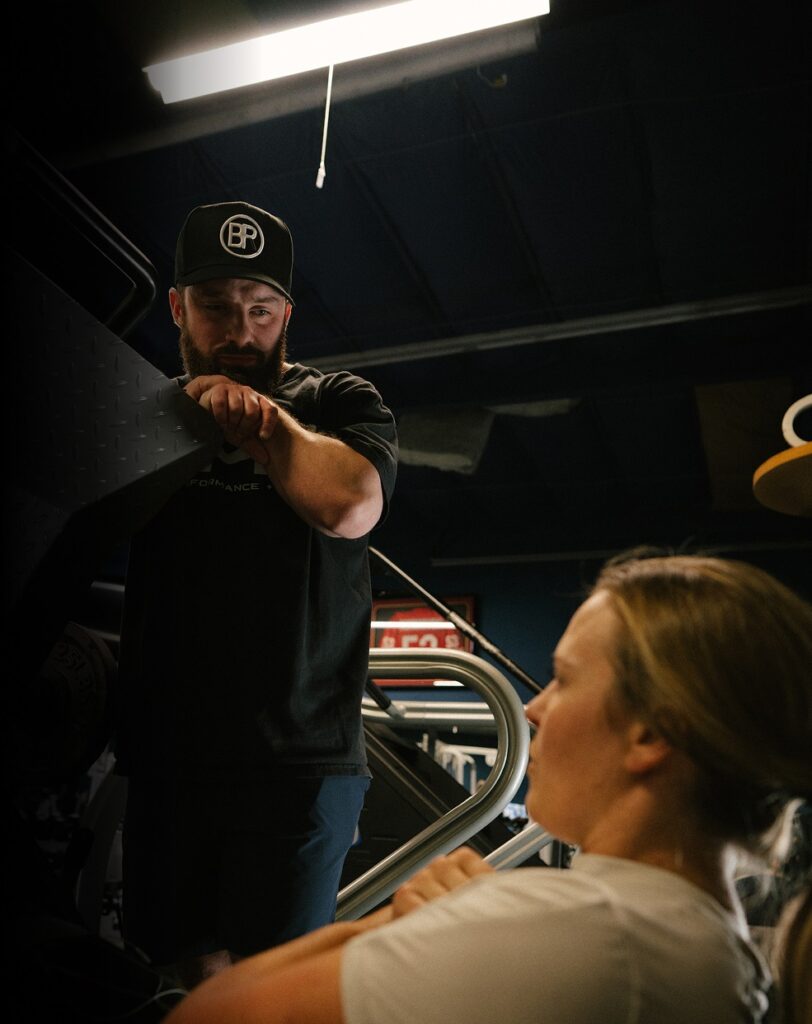
Your first session starts with where you are right now.
We look at your surgery, your motion, your strength, how you move, and what you’re trying to get back to.
Then we build the plan from there.
Every session is 60 to 90 minutes, one-on-one with your doctor. No aides. No rotating through providers who don’t know your history or your surgical details. Your plan will likely progress through several distinct phases, and we move you forward based on what your body is actually showing us, not on a predetermined timeline.
We also use blood flow restriction training in post-surgical rehab. It allows us to build meaningful strength in the weeks after surgery when heavy loading isn’t yet appropriate. Low load, high stimulus, significant strength response. It’s one of the most valuable tools we have in early post-surgical rehabilitation.
Every surgery is different and every person is different. But most post-surgical rehab moves through a similar arc.
In the middle phase we shift toward rebuilding strength and movement capacity. This is where most standard PT ends. For us it's where things start to get interesting.
We are loading the repaired structure progressively, addressing the compensations that developed during the acute phase, and starting to connect your rehab to the physical demands of your life and sport.
In the later phase we are building toward full return.
That looks different for everyone. For an athlete it means sport-specific loading, power development, and the confidence that comes from proving to yourself that the repaired area can handle real demands.
For an active adult it means hiking, lifting, cycling, or whatever the thing is that they came to us to get back to.
We don’t discharge you when you feel okay. We discharge you when you’re ready.
The research on post-surgical outcomes is consistent on one point. The quality and completeness of rehabilitation has a greater influence on long-term outcomes than the surgery itself in most cases. A well-executed surgery followed by incomplete rehab produces worse outcomes than a well-executed surgery followed by thorough, progressive, performance-focused rehabilitation.
That isn’t our opinion. It’s what the literature says repeatedly across rotator cuff, meniscus, labrum, and Achilles repairs.
The athletes and active adults who come out of surgery and genuinely get back, not just get by, are the ones who treated rehab with the same seriousness they treated the surgery. They found a clinician who progressed them properly, didn’t stop at pain free, and built them back to full capacity.
That’s what we are here to do.
As soon as your surgeon clears you. In many cases that’s within days of surgery. Early rehab, even gentle movement and muscle activation, produces better long-term outcomes than waiting until the acute phase has fully resolved. If you aren’t sure when to start, call us and we’ll help you figure out the right timing based on your specific surgery.
Yes, if you don’t feel fully back. Being discharged from post-surgical PT means your insurance coverage ended or you hit a functional baseline. It doesn’t mean your rehab is complete. Many of our best outcomes come from people who finished standard PT and still had significant strength deficits, movement limitations, or performance goals they had not reached.
The PT you did right after surgery was focused on protecting the repair and restoring basic function. What we do is focused on returning you to full performance. That means progressive loading, strength development, movement coaching, and sport-specific work that most standard post-surgical PT doesn’t have the time or the mandate to deliver.
It helps, but it isn’t required. If you have your surgical report or operative notes, bring them. If not, we’ll work with what you have and request records if we need them. Don’t let missing paperwork stop you from booking.
It depends on the surgery, how long ago it was, and what you’re trying to get back to. Someone coming in two weeks post-op is in a different place than someone coming in eight months post-op who has plateaued. We give you a realistic timeline at your first visit based on where you actually are, not a generic estimate.
Yes. We see this regularly. Old surgeries with incomplete rehab leave compensations, strength deficits, and movement problems that show up years later as recurring pain or performance limitations. We take a fresh look at what is going on and build from where you are now.
No. You don’t need a referral to start with us. Once you’re scheduled, we’ll handle the out-of-network benefits check for you.
Yes, we have an ACL rehabilitation program. If you’re recovering from ACL surgery, see our ACL Rehab pages for the full program details.
We are an out-of-network provider. You pay at the time of service and we submit a superbill, which is an itemized receipt, to your insurance carrier. If you have out-of-network benefits and have met your deductible, your insurance may reimburse you directly. In some cases you may be surprised by how much you get back. HSA and FSA funds are generally eligible.
Questions about your plan? We are happy to help before you book.
For full insurance and pricing details, call us at (925) 397-0399 or contact us here.
Book your post-surgical evaluation and leave with a plan built around where you are now and where you need to get to.