You’ve been modifying your workouts for weeks. Maybe months. Scaling movements you used to own, avoiding the barbell on bad days, telling yourself it will sort itself out if you just back off for a while.
It isn’t sorting itself out. And you already know that.

Strength athlete rehab is physical therapy for people who lift, train, and compete at a high level.
It isn’t about telling you to stop. It’s about understanding what your training demands from your body, finding what broke down, and building you back into it the right way.
The difference between a PT who works with strength athletes and one who doesn’t isn’t just experience.
It’s a completely different set of questions.
A PT who doesn’t understand lifting will tell you to avoid the squat until it feels better.
A PT who does will ask what your squat looks like at 80% of your max under fatigue, where you break down, and what upstream weakness is driving the problem.
That’s the kind of PT you’re looking for. That’s what we do here.
It’s also for the person who went to a PT, was told to stop lifting, and left feeling like that provider had no idea what they were asking them to give up.
You don’t have to stop lifting.
You need the right plan.
Most Physical Therapy Is Built For
That’s a reasonable standard for a lot of people.
What You’re Actually Doing
The demands that strength training places on the body are specific and significant. The ranges of motion required in Olympic weightlifting alone are extreme by any clinical standard. The spinal loading in a heavy deadlift. The shoulder position in an overhead squat.
The hip mechanics in a deep squat with load. These aren’t movements most PTs are trained to evaluate or rehabilitate around.
They require a clinician who understands the sport from the inside.
We train at CrossFit Pleasanton.
We know what these movements demand because we do them. That changes everything about how we evaluate a strength athlete, what we look for, and how we build the plan to get you back.
Strength training exposes weak links fast. Sometimes the pain is where the problem is. Sometimes it’s where the problem shows up after something else breaks down. Here are the issues we see most often.
If pressing, snatching, kipping, or overhead work keeps lighting up your shoulder, we look at more than the joint. Mobility, stability, rotator cuff strength, shoulder blade control, and loading all matter.
Heavy squats and pulls ask a lot from your hips. If depth feels blocked or your hip has felt off for months, we look at mobility, mechanics, strength, and how you’re loading the joint.
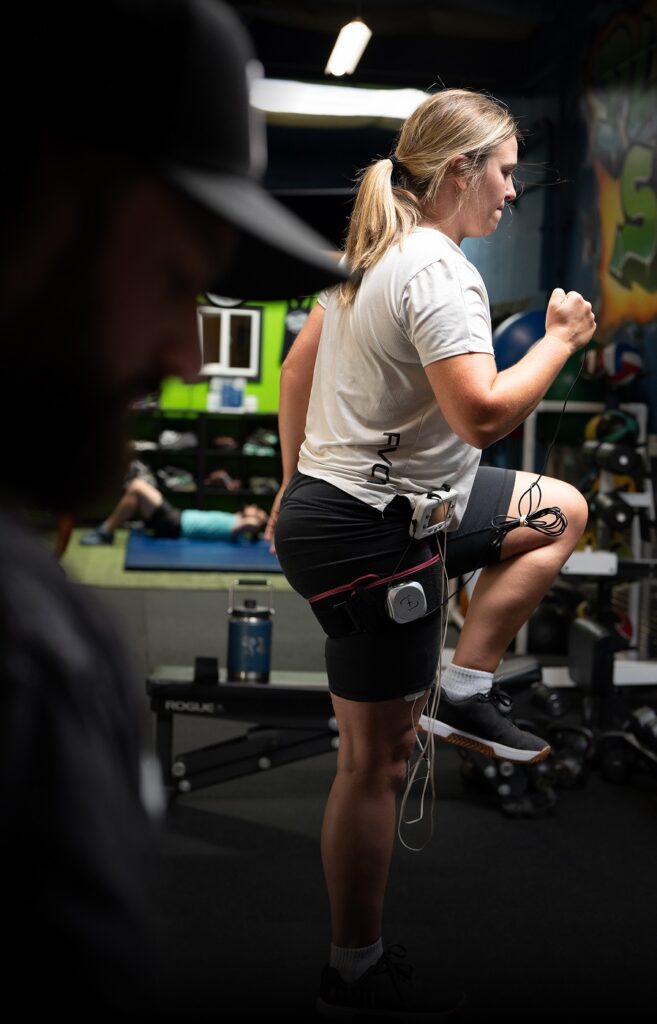
Your first session starts with your training.
We want to know what you’re lifting, what hurts, what movements you’ve changed, how long this has been going on, and what you’ve already tried.
Then we watch how you move. We look at where you lose position, where your body compensates, and what you can actually handle right now.
From there, we build the plan around your training, your movements, and your goals.
Every session is 60 to 90 minutes, one-on-one with your doctor. You won’t get handed a generic protocol or passed off to someone who doesn’t understand what you’re trying to get back to.
The goal is to keep you in the gym as much as possible while we fix what needs to change. That might mean modifying a movement, adjusting load, changing volume, or rebuilding capacity before you return to full intensity. It rarely means stopping altogether.
Your plan changes as your body changes. That’s how we get you back under the bar with more confidence.
60–90
Minutes One-on-One
1:1
With Your Doctor, Every Time
BFR
Used When It Fits Your Stage of Rehab
We hear this more than we should.
Someone comes in with a shoulder problem or a knee issue, and the PT tells them to stop CrossFit. No timeline. No plan to get back. Just stop.
That advice comes from a provider who doesn’t understand the sport well enough to build around it.
Telling a CrossFit athlete to stop CrossFit isn’t a treatment plan. It’s the absence of one.
We have never told someone to stop doing the thing that matters to them without having a real plan to get them back to it.
If stopping a specific movement temporarily is part of the plan, it’s temporary, it’s specific, and it’s explained.
There is a reason, a timeline, and a path back.
That’s what you deserve from your PT. Nothing less.
Not usually. In most cases the goal is to keep you training while we modify what needs to change. That might mean scaling certain movements, adjusting load, or temporarily avoiding a specific range of motion while we rebuild capacity there. Complete rest is rarely the answer and almost never the plan here.
Yes. If you’ve a meet, a competition, or an event on the calendar we build the plan around it. That means being honest about what your body can handle between now and then, what we can realistically address in that timeframe, and what the plan looks like after the event is done.
Sometimes load is a factor. More often it’s a movement pattern, a strength imbalance, or a mobility limitation that made a particular load too much for where your body was that day. We find the actual driver rather than just telling you to lift less.
That’s one of the most common situations we see. Chronic injuries in strength athletes are often more complicated than acute ones because the body has built compensations around the problem over time. We take the time to unwind what has built up and address the root cause rather than just the most recent flare-up.
Yes. Movement coaching is part of what we do. If a technique issue is contributing to the injury we address it as part of the plan. That’s different from a general coaching session but if your squat mechanics or pulling pattern is part of why you’re hurting, fixing the movement is part of fixing the injury.
Yes. The injury patterns differ somewhat across disciplines but the approach is the same. We understand what each sport demands and we build the plan around getting you back to competing and training at your level.
No. In California you can start physical therapy without a physician referral. Once you book, we’ll handle the out-of-network benefits check for you.
A coach addresses performance. We address the injury and the movement patterns that contributed to it. In many cases the two overlap, especially when technique is a factor, but the focus here is on your body, what is broken down, and how to rebuild it so you can train without limitation.
We are an out-of-network provider. You pay at the time of service and we submit a superbill, which is an itemized receipt, to your insurance carrier. If you have out-of-network benefits and have met your deductible, your insurance may reimburse you directly. In some cases you may be surprised by how much you get back. HSA and FSA funds are generally eligible.
Questions about your plan? We are happy to help before you book.
For full insurance and pricing details, call us at (925) 397-0399 or contact us here.
Book your strength athlete evaluation and leave with a plan built around your training, your movements, and your goals.