
Maybe a race on the calendar or a distance you’ve been building toward for months. And something keeps getting in the way.
You’ve tried rest. You’ve tried backing off the mileage. You’ve tried pushing through. None of it is working the way you need.
And you’re running out of time and patience.
Running and endurance rehab is physical therapy for runners, cyclists, triathletes, and endurance athletes. It’s built around the demands of high-volume, repetitive-load training. The goal is to get you back to full training without the same injury coming back again.
Basic rehab may calm the painful spot.
Running rehab has to solve why it started hurting in the first place.
That means looking at your training load, what your body could handle, and what needs to change before you build mileage again.
Rest isn’t a plan. A real plan gets you back.
Running Groups
Tri-Valley Running Club
The Tri-Valley Running Club runs weekly group runs in Pleasanton, San Ramon, and Livermore and trains as a group for local races including the Livermore Valley Half Marathon.
Fleet Feet Pleasanton Run Crew
Fleet Feet Pleasanton hosts a free Run Crew on Tuesday and Saturday mornings for runners of every pace and background.
Local Trails
Trail runners have access to some of the best routes in the Bay Area right here including the Arroyo Mocho Trail, Pleasanton Ridge Trail, and Iron Horse Trail.
Arroyo Mocho Trail
Pleasanton Ridge Trail
Iron Horse Trail
What Shows Up Where
Shin splints when mileage ramps up for a half marathon training block.
IT band pain on the descents at
Pleasanton Ridge.
Achilles problems that show up mid-training cycle and don’t resolve on their own.
The Tri-Valley has one of the most active running communities in the East Bay. This community runs year round, trains hard, and deals with the injuries that come with that. We work with runners from across this community.
If you train here, race here, or run these trails, you’re exactly who we built this practice for.
This page is for you if you’re a runner, cyclist, triathlete, or endurance athlete dealing with an injury or recurring pain that keeps interrupting your training.
A knee that speaks up on long runs.
Plantar fasciitis that feels fine in the morning and ruins every afternoon run.
It’s also for the endurance athletes who have a race on the calendar and are watching the clock. You don’t have time for a slow recovery.
You need someone who understands your training, your timeline, and what your body needs to handle again.
Running injuries are almost never just about the painful spot. They’re about load.
Your body has a capacity. Your shin, knee, Achilles, plantar fascia, and other tissues can only handle so much stress before something starts to break down.
When your training load passes what your body is ready for, something speaks up.
That’s why rest often feels like it works at first. The pain calms down.
Then you return to the same mileage, pace, hills, or volume, and the same problem comes back.
Research in the British Journal of Sports Medicine points to training load errors as a major driver of running-related overuse injuries.
Doing too much too soon can overload tissue before it has rebuilt the capacity to handle it.
That isn’t bad luck. It’s a mismatch between what you’re asking your body to do and what it’s prepared to handle right now.
We address both sides of that equation. We rebuild the tissue capacity and we build you back into your training load the right way so the mismatch doesn’t happen again.
Running injuries usually show up in one spot. The real issue is often the load, strength, mechanics, or training pattern behind it.
Here are the issues we see most often.
Shin Splints and Medial Tibial Stress Syndrome
If shin pain shows up every time you build mileage, rest may calm it down. It won’t rebuild the capacity your bones and soft tissue need to handle training.
IT Band Pain
The IT band usually isn’t the whole problem.
We look at hip strength, knee control, running mechanics,
and how load moves through your stride.
If you aren’t sure whether we work with your specific surgery, call us and we’ll tell you honestly whether we are the right fit.
Your first session starts with your training.
We look at your weekly mileage, what changed before the pain started, how long it’s been going on, and what you’ve already tried.
Then we look at how you move and run. We want to see where your body breaks down under load and what your tissue can handle right now.
From there, we build the plan around your training goals, your race calendar, and what your body needs to handle again.
Every session is 60 to 90 minutes, one-on-one with your doctor. You won’t get handed a generic protocol or passed off to someone who doesn’t know your history.
The goal is to keep you training as much as possible while we fix what needs to change.
That might mean adjusting mileage, changing pace, modifying terrain, adding cross-training, or rebuilding strength before you return to full volume.
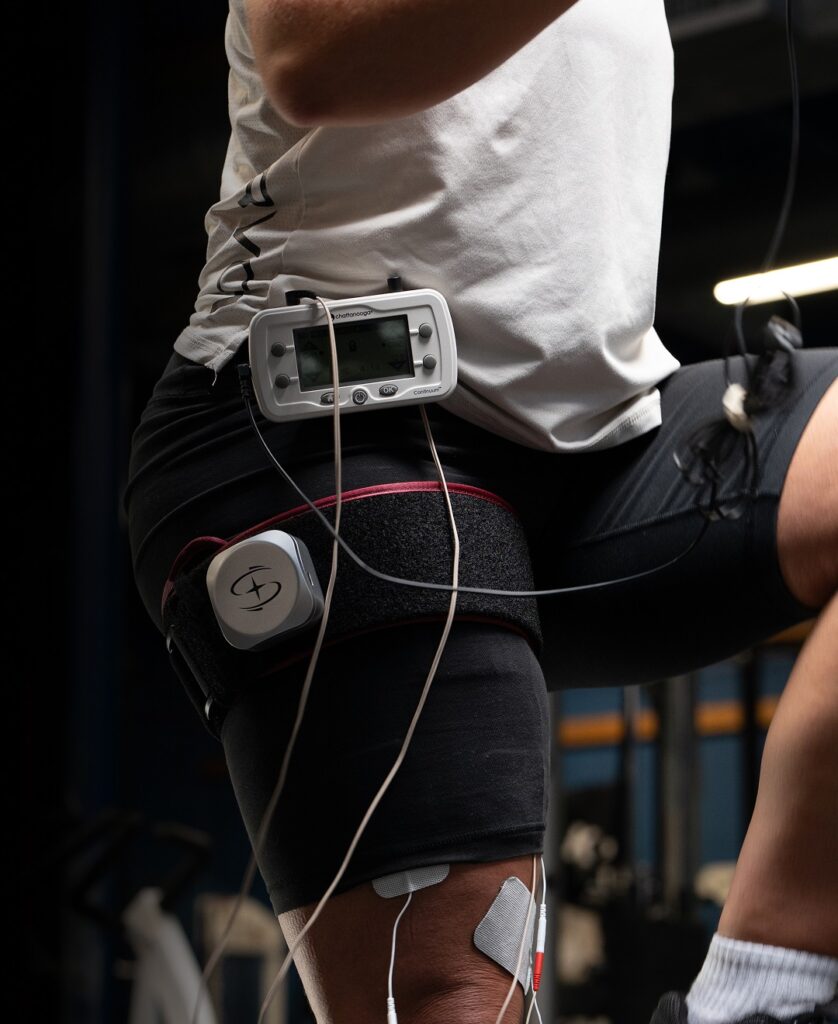
We may also use blood flow restriction training when it fits your injury and stage of rehab. BFR helps build strength with lighter loads, which can be useful for tendon injuries like Achilles tendinopathy or patellar tendinopathy.
If you have a race on the calendar we want to know about it on your first visit.
A race date changes the math. It means we need to be clear about what’s realistic, what we can address in the time available, and what the plan looks like between now and race day.
Sometimes the answer is that we can get you there. Sometimes it means a conversation about modifying the goal for this race
and doing it right so the next one isn’t compromised too.
Not usually. In most cases we modify your training rather than eliminate it. That might mean reducing mileage temporarily, changing your surface, adjusting pace, or cross-training to maintain fitness while the injury heals. Complete rest is rarely the right answer and it’s almost never the plan here. We keep you moving as much as your body will allow while we address what needs to change.
Yes, but we need to be honest about what is realistic in that timeframe. Book your evaluation as soon as possible so we have maximum time to work with. We’ll tell you at your first visit what we can address before race day and what the plan looks like to get you there in the best shape possible.
Because the underlying issue was never fully addressed. Shin splints are a load management problem. The bone and soft tissue in your shin have a certain capacity and when you ask them to handle more than that capacity allows, they react. Rest calms the reaction but doesn’t build the capacity. The next time you ramp up mileage the same thing happens. We address the capacity side so the mismatch stops happening.
The IT band is a thick band of connective tissue that runs along the outside of your thigh from your hip to your knee. It doesn’t actually stretch much and treating it with foam rolling and stretching is one of the most common mistakes in running injury management. IT band syndrome is almost always a hip strength and load management problem. When the hip isn’t doing its job, the IT band compensates and gets irritated at the knee. We treat the hip, not the band.
It depends on how long it has been present and how it has been managed up to this point. Plantar fasciitis responds very well to progressive loading but poorly to prolonged rest followed by a sudden return to activity. Most people who come to us with plantar fasciitis see meaningful improvement within four to eight weeks with the right loading program. Long-standing cases take longer but they still respond well to the right approach.
Yes. We work with cyclists, triathletes, and endurance athletes across disciplines. The injury patterns vary somewhat but the approach is the same. We understand what your training demands, we find what broke down, and we build the plan around getting you back to full training.
You don’t need a referral to get started. Once you book, we’ll handle the out-of-network benefits check for you.
Medial tibial stress syndrome is the clinical term for shin splints. It refers to pain along the inner edge of the shinbone that develops in response to repetitive loading, most commonly in runners who have increased their training volume faster than their bone and soft tissue can adapt. It’s one of the most common running injuries and one of the most commonly undertreated because rest alone doesn’t address the underlying capacity deficit.
We are an out-of-network provider. You pay at the time of service and we submit a superbill, which is an itemized receipt, to your insurance carrier. If you have out-of-network benefits and have met your deductible, your insurance may reimburse you directly. In some cases you may be surprised by how much you get back. HSA and FSA funds are generally eligible.
Questions about your plan? We are happy to help before you book.
For full insurance and pricing details, call us at (925) 397-0399 or contact us here.
Book your running and endurance evaluation and leave with a real plan built around your training and your timeline.